
Complete Guide to Gibbs Reflective Cycle With Examples
The Gibbs Reflective Cycle is one of the most widely used frameworks for organising this process. Developed by Graham Gibbs in 1988, the model provides learners with a structured way to move from an experience to reflection and future action.
Reflective writing asks you to do more than describe something that happened. You need to think about the experience, examine your response to it, understand what you learned and consider what you would do differently next time.
It is commonly used in education and professional development. Keep reading to understand each stage to make your reflective assignments easier to plan and help you move beyond simple description.
What Is the Gibbs Reflective Cycle?
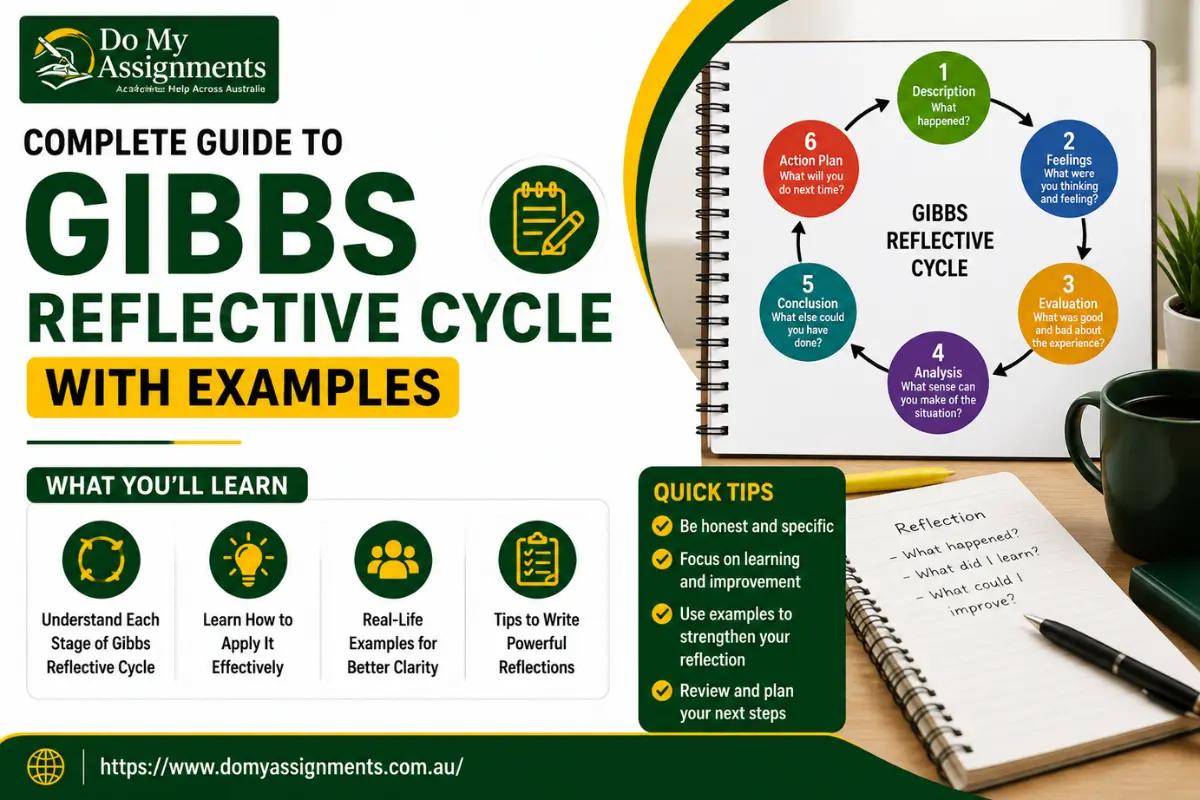
The Gibbs Reflective Cycle is a six-stage model that helps people reflect systematically on an experience.
The six stages are:
1. Description
2. Feelings
3. Evaluation
4. Analysis
5. Conclusion
6. Action Plan
The framework encourages you to look at an experience from different angles instead of simply explaining what happened.
A lot of students start by asking someone to write my assignment for a better understanding of how to present this self-reflection. One good written example from an expert helps them write more effective answers using this model.
1) Description: What Happened?
The first stage establishes the situation you are reflecting on.
Keep this section focused. You do not need to provide every detail surrounding the event. Include enough information for the reader to understand what happened and why the experience is worth reflecting on.
Consider:
· Where did the event take place?
· Who was involved?
· What were you expected to do?
· What actually happened?
· What was the outcome?
Example
During a group presentation at university, I was responsible for explaining the final section of our research. When the presentation began, one group member was absent, so I had to cover part of their section as well as my own.
Notice that this describes the event without attempting to explain whether it was good or bad. The deeper reflection comes later.
2) Feelings- What Were You Thinking and Feeling?
The second stage focuses on your emotional response.
This does not mean simply writing, “I was nervous.” Strong reflection explores why you felt that way and how your emotions may have influenced your actions.
You might consider:
· What were you thinking before the event?
· How did you feel during it?
· Did your feelings change?
· How did your emotions affect your behaviour?
· How might others involved have felt?
Example
Before the presentation, I felt prepared because I had rehearsed my section several times. When I learned that my group member was absent, however, I became anxious because I had not prepared their material. I noticed that I began speaking more quickly, which made some parts of my explanation less clear.
This connects feelings with behaviour rather than simply listing emotions.
3) Evaluation: What Went Well and What Did Not?
At this stage, consider the positive and negative aspects of the experience.
Try to be balanced. A reflective assignment should not become an attempt to blame other people or prove that everything went wrong.
Think about:
· What worked well?
· What problems occurred?
· How did your actions affect the outcome?
· What did other people contribute?
· Was the final result what you expected?
Example
One positive aspect was that I was able to continue the presentation despite the unexpected absence. My preparation for my own section helped me remain organised. However, I had not prepared enough material outside my assigned section, which affected my confidence and delivery.
The evaluation should prepare the reader for the deeper analysis that follows.
4) Analysis: Why Did It Happen?
Analysis is often the deepest part of a reflective assignment because this is where you explore the reasons behind the experience.
Ask why things happened the way they did.
Quick example: You took online exam help. What were the factors that led to it? Lack of time? Improper time management? Weak understanding of the subject matter?
You can connect your experience with:
· Academic theories.
· Research.
· Professional standards.
· Previous experiences.
· Skills or knowledge.
· Different perspectives.
Example
The situation highlighted the importance of preparation beyond an individual’s assigned role in group work. Although dividing responsibilities can make a project more manageable, relying too heavily on separate sections can create difficulties when an unexpected problem occurs. Research on teamwork also emphasises communication and shared responsibility, suggesting that our group could have reduced the risk by reviewing each other’s sections before the presentation.
This is more analytical than saying, I should have prepared more.
5) Conclusion: What Could You Have Done Differently?
The conclusion in the Gibbs Reflective Cycle brings together what you have learned from the experience.
Do not introduce a completely new issue here. Instead, identify the main lesson that emerged from your reflection.
Consider:
· What did you learn?
· What would you change?
· What skills need improvement?
· Could the situation have been handled differently?
I learned that effective group preparation requires more than completing an individual section. While preparing my assigned material was useful, I should also have developed a basic understanding of the other sections. This would have allowed me to respond more confidently when circumstances changed.
You need to be realistic here and consider what you could have done both ways, instantly and in the long-term.
6) Action Plan- What Will You Do Next Time?
The final stage turns reflection into practical action.
Explain what you will do if you encounter a similar situation again. Your plan should be specific rather than vague.
Instead of writing:
“I will be more prepared next time.”
You could write:
For future group presentations, I will review the complete presentation with my group at least one day before the session and prepare brief notes for each section so that I can support the team if someone is unavailable.
This gives your reflection a clear outcome.
FAQS
1) Could Gibbs Reflective Cycle be used for both good and bad experiences?
Yes. There is no necessity that the experience must be bad in order for reflection to take place. A good experience can provide important lessons as well, such as what skills were helpful in achieving the result and where else those skills could be used in the future.
2) Should I write each stage of Gibbs as a separate heading?
It depends on your assignment requirements. The writing of Gibbs’ six stages as headings may help to clearly structure the paper, but certain institutions might prefer a continuous essay format. Always follow the requirements for your particular assignment.
3) Is it allowed to use “I” in a Gibbs reflective essay?
Usually yes. Reflection is about analysing one’s own ideas and actions; therefore, using first-person is acceptable. However, the required academic style might differ from course to course.
Key Takeaways
Gibbs Reflective Cycle offers an effective structure for turning your experience into reflection. Six stages of description, feelings, evaluation, analysis, conclusion and action plan will help you progress from a description of the situation to its interpretation and understanding of its impact on your further actions—a crucial approach for completing academic reflective assignments effectively.
It is crucial to remember that the structure shouldn’t be regarded as a rigid formula. The most successful reflective writings use the stages in developing their content, combine personal experience with theoretical knowledge or evidence, use tools like an AI Detector to ensure authenticity, and end up with an attainable action plan for improvement.